

BMW K100 common problems and solutions: the complete troubleshooting guide
BMW K100 common problems and solutions: the complete troubleshooting guide
The BMW K100 is a legendary motorcycle. Its laid-down, longitudinally mounted inline four, nicknamed the flying brick, was far ahead of its time in the early eighties: liquid cooling, Bosch LE-Jetronic fuel injection and shaft drive. It is no accident that these bikes are still on the road. But let us be honest: even these German workhorses have their quirks. If you own a K100, K100RS, K100RT or K100LT, you know it is a motorcycle with character. And character sometimes means needing a bit of extra attention.
In this guide, we walk you through the most common BMW K100 problems and solutions. We talk about what really happens in the workshop, not theoretical nonsense. This is the troubleshooting guide you actually need, written by people who know these bikes.
Engine will not start: causes and fixes
The worst thing that can happen: you get on, turn the key, and nothing. Silence. Frustration. Let us figure this out.
Poor connections and wiring
This is the first place to look. Many K100s are now around 40 years old. The original wiring, especially around the battery and starter motor, may have oxidised. That green patina on copper contacts? That is your culprit.
First check your battery terminals. They should be shiny clean: no green, no white powder. If you see oxidation, remove it with a wire brush or fine sandpaper. This alone solves a surprising number of cases.
Next, check the starter motor wiring and the main ground straps. Connectors can work loose over the years. Give them a gentle tug: they should sit tight. Dark or melted plastic means a connector has been running hot and needs replacing.
Weak battery or charging problem
Your engine cranks slowly, or the starter will not turn at all? Probably the battery. Depending on the year, a K100 came with a 12 volt battery of 20 Ah (up to 1986), 25 Ah (from 1987) or 30 Ah (optional, standard on the K100LT). Many bikes are still running a tired old unit.
A modern gel battery is one of the best-known K100 upgrades: it holds its charge better during storage, cannot spill acid and gives reliable cranking power. Combine it with clean terminals and a healthy charging system and most starting drama disappears.
Starter motor problems
Sometimes the relay just clicks, click, click, click, but the starter does not turn. This usually means the carbon brushes in the starter motor are worn out. You can remove the starter and have it overhauled; that is cheaper than a new one and usually just as reliable.
Cooling system: the best-known K100 weak spot
The K100 is liquid cooled, and the cooling system is where this model shows its most famous ailment.
Water pump seal leakage
This is virtually universal on older K100s: the water pump seals wear out. You notice it in one of two ways. Either a coolant trail or drips under the pump housing, which means the weep hole is doing its job, or in the worst case coolant mixing with the engine oil, which turns the oil milky. Check under the pump regularly and keep an eye on your oil.
Replacing the seals is a well-documented job that mostly takes patience. While you are in there, renew the coolant: glycol antifreeze mixed 50:50 with water protects down to minus 36 degrees. The system takes 2.8 litres plus 0.4 litres in the expansion tank. No plain tap water: that causes corrosion and new leaks.
Overheating
The temperature gauge climbs the moment you hit traffic. Check the basics first: coolant level, then the thermostat. A thermostat stuck closed keeps the radiator cold while the engine runs hot; replacement is the only fix. A radiator clogged with old, neglected coolant can also be the cause. Flushing it properly is not a beginner job.
Air in the system
After coolant work you can end up with air pockets, and the engine will run hot in no time. Bleed the system slowly: warm the engine up and carefully let the air escape until the coolant flows evenly. Take your time here.
Ignition and sensors
An engine that runs rough or dies can point to the ignition side, and the K100 has a few well-known suspects.
Hall sensor failure
The classic symptom: the bike starts and runs fine, warms up, then suddenly dies, and refuses to restart until it has cooled down. That is the Hall sensor unit. The wiring insulation gets brittle with age and engine heat and starts shorting when hot. The fix is replacing or rewiring the Hall sensor plate. If your K100 strands you when warm, check here first.
Ignition coil failure
The K100 uses two double-ended ignition coils in a wasted spark setup: one coil fires cylinders 1 and 4, the other cylinders 2 and 3. If a coil dies, you lose two cylinders at once, and you will feel it immediately: the engine runs extremely rough and barely pulls. Swapping the leads between coils helps you confirm the diagnosis before buying parts.
Spark plugs
Worn plugs cause hard starting and rough running. The stock plug is a Bosch X5DC (NGK equivalent D7EA), gapped at 0.6 mm when new. They are cheap: replace them rather than blame them.
Fuel injection: no carburetors here
Let us clear up a persistent misunderstanding: the K100 has no carburetors. It was one of the first mass-produced motorcycles with electronic fuel injection, the Bosch LE-Jetronic. There is no choke either: a fast idle lever raises the idle speed for cold starts. That injection system is robust, but on a bike this age a few things deserve attention.
Dirty injectors
An engine that starts but runs rough and drinks fuel may have clogged injectors. After decades of use and stale fuel they no longer atomise properly. Having them ultrasonically cleaned and flow-tested is far cheaper than replacement, and it often transforms how the engine runs.
Fuel pump and tank filter
The fuel pump and its filter live inside the tank. A tired pump or a clogged filter causes low fuel pressure: weak starting, stumbling under load, poor top-end power. If the pump gets noisy or the bike leans out at speed, inspect both. The tank filter is a service item that is often forgotten for decades.
Rust in the tank
A K100 that has been sitting for years often has rust in the tank. Those flakes end up in the tank filter and the pump. Look inside the tank with a torch; if you see rust, have the tank cleaned and sealed before it takes out your fuel system.
Temperature sensor and fast idle
A faulty engine temperature sensor feeds the injection system wrong information, and the engine runs too rich or poorly when cold. Also check that the fast idle lever and its cable actually work: a sticking fast idle mechanism is a common cause of cold-start complaints that get blamed on everything else.
Timing chain tensioner: the famous cold-start rattle
Do you hear a rattle from the front of the engine for the first seconds after a cold start? That is the timing chain tensioner, a well-known K100 issue. The tensioner bleeds down while the bike sits, and until oil pressure builds up, the timing chain rattles. A short rattle that disappears quickly is common; a rattle that stays or gets worse means the tensioner, and possibly the chain and guides, is due for replacement.
To be clear: this is the timing chain inside the engine. The K100 has shaft drive, so there is no drive chain to adjust or replace.
Gearbox and shaft drive
The K100 drivetrain is simple and strong: a separate gearbox and a shaft final drive.
Heavy or notchy shifting
K100 gearboxes are never featherlight, but if shifting gets worse, start with the oil. The gearbox takes 0.85 litres of hypoid oil, API GL-5, SAE 90 above 5 degrees or SAE 80W-90. Fresh oil of the correct spec makes a noticeable difference.
Grease the driveshaft splines
This is the K100 maintenance point that gets skipped most often: the driveline splines need periodic greasing. Do it whenever the rear wheel or swingarm is out anyway. Neglected splines wear, and that repair is expensive. The final drive itself takes 0.26 litres of the same GL-5 hypoid oil; renew it periodically.
Oil leaks
Stains on the driveway usually come from aged seals between engine, gearbox and final drive. Small seeps are common on bikes this age; active drips deserve investigation and fresh seals.
Chassis and suspension: long-term wear
The K100 chassis is solid, but decades take their toll.
Steering head bearings
A notchy feeling in the steering, or the bars falling into a straight-ahead detent, points to worn steering head bearings. This affects your control over the bike, so do not postpone it. Replacing them means removing the front fork and the triple clamps so the old races can be pressed out; the fork legs themselves do not need to be disassembled. Afterwards the bearings are adjusted free of play, as the factory prescribes.
Tired rear suspension
A K100 that wallows or crashes over bumps needs a new shock absorber. Hagon and YSS both supply quality replacement shocks for BMW classics, matched to your weight and riding style. This is one of the upgrades you feel on every single ride.
Brakes: safety first
Worn brakes are not just annoying, they are dangerous.
Brake fluid
Brake fluid absorbs moisture over time, which gives a soft lever and can corrode the system from within. BMW specifies DOT 4, renewed every year. It is a small job that pays off every time you brake.
Pads and discs
Longer stopping distances or vibration under braking? Check the pads and discs. Quality aftermarket pads are readily available for the K100. A shudder under hard braking usually means warped discs: replace them, do not try to work around it.
Air filter and intake
An engine that runs rich or struggles to breathe may simply have a clogged air filter. Hold it up to the light: if nothing shines through, replace it. Cheap insurance. Also check the intake rubbers for cracks; false air makes the injection run poorly.
Modern upgrades that make sense
If you want to make your K100 more reliable and more enjoyable, some modern upgrades genuinely help.
Lighting first: the original headlight is weak by modern standards. LED lighting from brands like Kellermann and Motogadget gives you real visibility, draws less current and looks right on a classic build.
Suspension second: YSS shocks tuned for your weight and riding style transform how the bike feels. Same bike, suddenly stable and controlled, even on bad roads.
And as mentioned: a gel battery is the quiet hero of K100 reliability.
The prevention principle
Here is what really matters: most BMW K100 troubleshooting can be prevented with proper maintenance.
Every 7,500 km or once a year: change the engine oil and filter. The engine takes 3.75 litres with a filter change; use a quality brand oil with viscosity matched to the season, such as 10W-40 or 15W-40.
Every year: renew the brake fluid (DOT 4).
Periodically: check the valve clearances on a cold engine (intake 0.15 to 0.20 mm, exhaust 0.25 to 0.30 mm), renew the gearbox and final drive oil, and grease the driveshaft splines.
Idle should sit around 950 rpm on a healthy engine. This schedule is not complicated, but it keeps the engine healthy. An hour of maintenance now saves ten hours of repair work later.
Winter storage
Storing the bike for winter? Fill the tank completely (a full 22 litre tank leaves no room for condensation and rust), put the battery on a maintenance charger and treat the engine to fresh oil before the break. Poorly stored bikes are the ones that refuse to wake up in spring.
Special advice for cafe racer builders
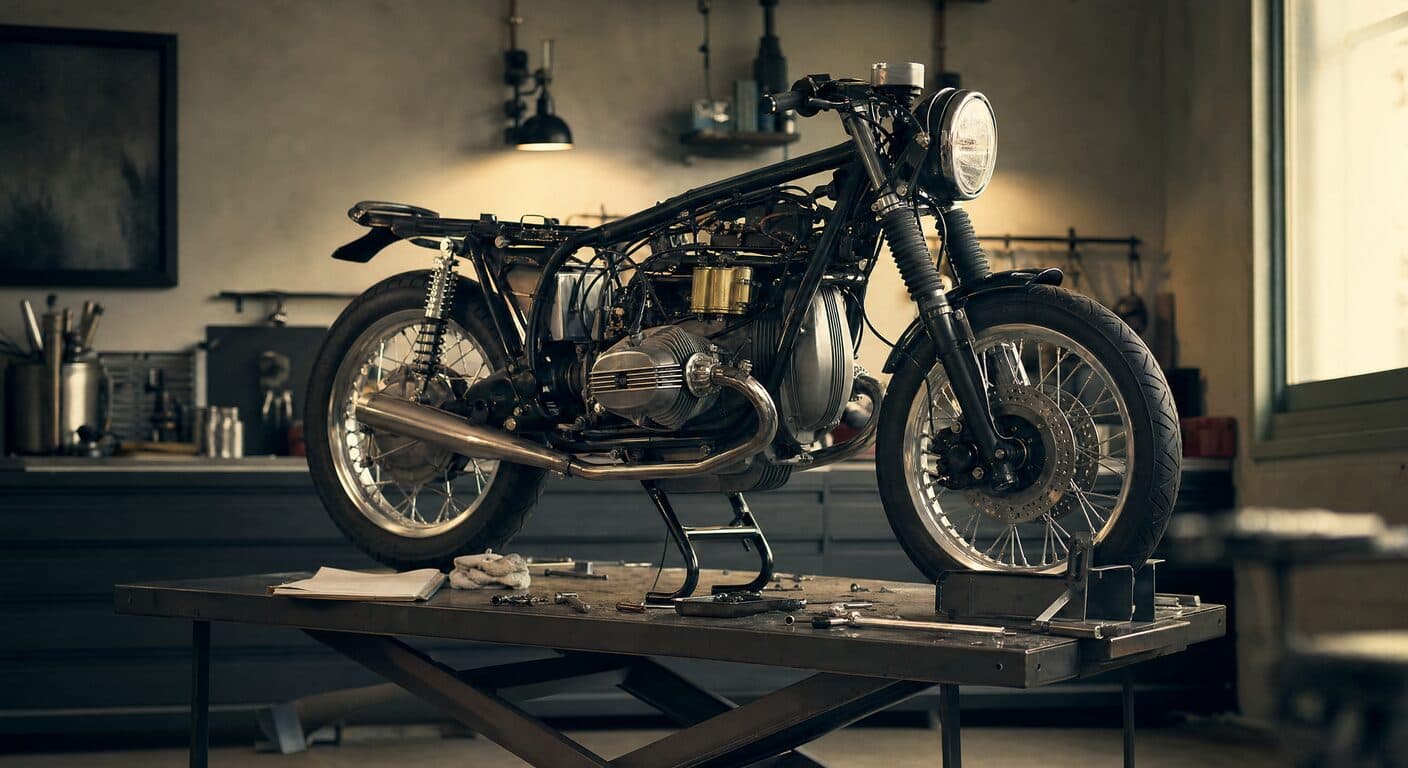
Converting your K100 into a cafe racer build brings its own challenges. Frame modifications can stress parts of the electrical system: make sure harnesses are not pinched or chafed, a common fire hazard on modified bikes. And treat the injection system with respect: the LE-Jetronic control unit, its sensors and wiring must stay intact and properly connected, or the bike will never run right. Plan your electronics before you cut anything.
Where to start when troubleshooting
Here is the method: always start simple. Check:
- Battery and connectors
- Fluid levels
- Fuses
- Air filter and intake rubbers
- Fuel pressure (tank filter and pump)
These checks solve most problems. Only then move on to sensors and deeper diagnosis.
The heart of BMW K100 problems and solutions
Actually, it is not that complicated. BMW K100 problems and solutions come down to basic physics: moving parts wear, contacts corrode, fluids degrade. What sets the K100 apart is how well it responds to care. Many K100s on the road today have passed 100,000 km, some 200,000 km. That tells you something.
Many of these problems you prevent with regular maintenance and replacing wear parts before they break. This is not sexy, but it works.
Professional help when needed
Sometimes you just need someone who really knows these bikes. That is fine. Look for a workshop with specific BMW K experience, not just a general motorcycle mechanic. The flying brick has its own logic, and someone who knows it saves you money.
In conclusion: enjoy your bike
A K100 is a great motorcycle: reliable, comfortable and full of character. Yes, it can act up. But that is part of owning a classic. Learn how your own bike works, understand its weak spots, keep up the maintenance. Then it will carry you for thousands of kilometres.
Your K100 deserves better than being neglected in a shed. Keep it running.
Ready to upgrade your K100?
If you want to modernise your K100 with reliable parts, we have what you need. From YSS suspension to Kellermann lighting, we select only what is truly better than original.
Stop by our shop in Haarlem, or browse our BMW Classic Builds collection online. We are happy to help you take your bike to the next level, with the right parts and good advice.
Frequently asked questions
Why does my BMW K100 start poorly in cold weather?+
The K100 has no carburetors or choke, but Bosch LE-Jetronic fuel injection with a fast idle lever for cold starts. If it starts poorly, first check the battery and connections: a tired battery or oxidised terminals are the most common cause. Then look at the spark plugs, the fast idle mechanism and the fuel pressure (tank filter and pump). A modern gel battery makes cold starting a lot more reliable.
My K100 rattles briefly after a cold start, is that serious?+
That rattle almost always comes from the timing chain tensioner, a well-known K100 issue. When the bike sits, oil pressure bleeds off and the timing chain rattles until the tensioner pumps up again. If the noise disappears after a few seconds, there is no acute problem. If it persists or gets worse, have the tensioner replaced. Note: this is the timing chain inside the engine. The K100 has no drive chain, it uses shaft drive.
My K100 dies once it warms up and will not restart, what is this?+
This is the classic symptom of a failing Hall sensor. After all these years the wiring insulation becomes brittle from engine heat and shorts out once the engine is up to temperature. After cooling down, the bike starts again as if nothing happened. The fix is replacing or rewiring the Hall sensor plate. If you recognise this pattern, do not chase fuel system ghosts: start at the Hall sensor.
What can I do about electrical problems on my K100?+
Many electrical complaints are simply poor contacts. Clean the battery terminals, ground points and connectors, and replace burnt or corroded plugs. Check the battery and charging system: a modern gel battery is a well-known reliability upgrade for the K100. If you want to improve further, choose LED lighting from brands like Kellermann or Motogadget: safer and easier on the electrical system. Regular inspection prevents a lot of frustration.